


9 November 2026
Medicines Made in Space: The New Race to Improve Cancer Treatments
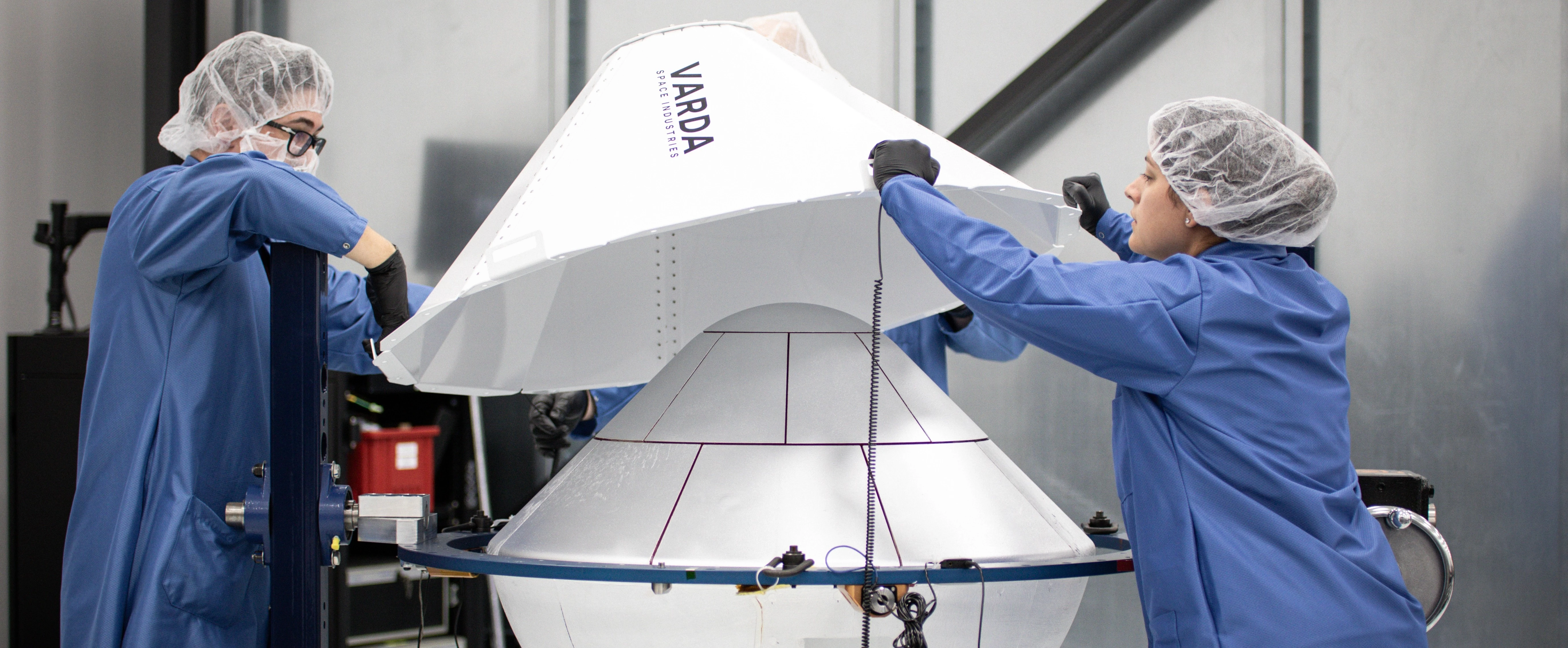
Varda Space Industries staff are working on the assembly of the W-2 space capsule. Photo: Varda Space Industries.
Hundreds of kilometers from Earth, a small capsule is conducting an experiment that seems more like something out of a science fiction movie: manufacturing crystals of a potential cancer drug. There are no astronauts inside, nor is it about preparing treatments for future space missions. The goal is much closer to us: taking advantage of space conditions to improve the medicines we use here on Earth.
The American company Varda Space Industries launched a mission on October 20 to study how some pharmaceutical compounds behave under the microgravity conditions found in orbit. It is one of the projects of an emerging industry exploring whether manufacturing part of the medicines in orbit could overcome limitations of Earth-based laboratories.
Why manufacture medicines in space?
The key lies in microgravity. On Earth, gravity influences many physical and chemical processes, including the behavior of particles when a substance crystallizes. In this process, molecules arrange themselves and form solid structures whose characteristics affect important properties of a medicine, such as its stability or how well it dissolves.
In space, microgravity reduces phenomena like sedimentation and some liquid movements, allowing the study of crystal formation without some of the usual interferences and, in certain compounds, this favors more uniform structures or features difficult to achieve on Earth.
This is important for the pharmaceutical industry because a medicine needs more than just an effective molecule: it must also maintain its properties during storage, reach the body in the correct amount, and be safely administered. Some promising substances face difficulties in development precisely because of this: they do not dissolve well or are hard to convert into a stable product. Hence, space experiments have sparked the interest of pharmaceutical companies and investors.
Space capsules turned into laboratories
Varda Space Industries is one of the companies that has put this idea into practice. Their capsules function as small automated laboratories: they travel to space on a rocket, conduct experiments in orbit, and return to Earth with samples for analysis.
The mission named W-7 is dedicated to a type of compound known as PROTAC. These are experimental molecules that aim to fight certain diseases by exploiting the mechanisms our cells use to eliminate proteins. In cancer, the idea is to promote the destruction of proteins involved in tumor growth. The problem is that some of these compounds crystallize poorly, which complicates their development as medicines. Researchers want to verify if microgravity allows obtaining structures more favorable for formulation and subsequent administration.
This is not the first time Varda has worked with pharmaceuticals outside Earth. In April 2026, the scientific journal npj Microgravity published the results of an experiment with ritonavir, an antiviral, conducted on their first mission (2023-2024). Researchers managed to produce and recover a crystalline form of the compound that maintained its physical and chemical stability during flight and return. The study confirmed that it is possible to process and recover certain pharmaceutical materials under these conditions, but it did not demonstrate that the obtained medicine was better than that produced on Earth. The current mission aims to advance in that direction.
From space to the hospital: easier-to-administer treatments
Another possibility that sparks interest in this type of research relates to how cancer medicines are administered. Some immunotherapies require intravenous infusions that force patients to spend considerable time in the hospital. Turning these treatments into formulations that can be administered via subcutaneous injection, that is, under the skin, would reduce some of those visits and simplify care.
The difficulty lies in that some molecules, especially proteins in certain treatments, require high concentrations to reach the appropriate dose. If a large amount is concentrated in a small volume, the solution can become too viscous to inject comfortably with a syringe.
What the British company BioOrbit is investigating is whether crystallization in microgravity helps solve this problem. In May 2026, it sent a device called Box-E to the International Space Station, designed to study how crystals of pharmaceutical proteins form. The mission has already concluded and, after about six weeks in orbit, the company claims to have achieved the largest production of protein crystals in space to date. Its co-founder and CEO, Katie King, explained to The Guardian that gravity particularly hinders the crystallization of large and flexible molecules, like those used in some antibody treatments. Obtaining suitable crystals would allow investigating more concentrated formulations that maintain a viscosity compatible with injections.
In the long term, the goal would be for these treatments to be administered with quick injections and even, when medical conditions allow, outside the hospital. For now, this is a development goal for BioOrbit, which still needs to demonstrate clinical viability.
But BioOrbit is not the first to explore this path. The International Space Station has hosted protein crystallization experiments for years, and Merck used them to address a very similar problem with pembrolizumab, the active ingredient in Keytruda, an immunotherapy against various types of cancer. In a study published in 2019 in npj Microgravity, their researchers explained that crystals formed in orbit produced more uniform and less viscous suspensions than those prepared on Earth, and these results helped them develop Earth-based production methods aimed at an injectable formulation. The subcutaneous version that the US FDA authorized in September 2025, Keytruda Qlex, follows a different path: it combines pembrolizumab with the enzyme hyaluronidase, which facilitates its administration under the skin.
The obstacles: cost and regulation
The main obstacle to manufacturing in orbit remains economic. Sending materials to space, maintaining equipment operation, and recovering products cost much more than doing so in a conventional facility, so companies will have to prove that the properties obtained justify that investment and that results can be consistently reproduced.
There is also a regulatory issue. Medicines processed in space will have to meet the same quality, safety, and efficacy requirements as any other, and authorities will need to evaluate how production is controlled under conditions so different from the usual.
For now, pharmaceutical manufacturing in orbit remains experimental, although commercial projects are advancing rapidly: Varda plans to increase from four launches this year to seven in 2027, and other companies are developing their own microgravity production systems. We do not know if it will become a common practice, but these first experiments help better understand how different pharmaceutical compounds behave outside Earth. Perhaps the future of some treatments will depend not only on discovering new molecules but also on finding new places to manufacture them.

